The Ultimate Guide to Technical SEO
Mastering the digital landscape requires more than just great writing; it demands a flawless structural foundation. This Ultimate Guide to Technical SEO explores the essential mechanics behind high-ranking websites.
This guide provides a deep dive into Technical SEO, covering site speed, mobile optimization, crawlability, and security. By implementing these actionable strategies, you will ensure search engines can effectively index your content, leading to sustainable organic growth and a superior user experience.
The Ultimate Guide to Technical SEO: Building a High-Performance Website
When it comes to search engine optimization (SEO), all roads lead to one primary goal: boosting your website’s performance in search engine rankings. While content creation and link-building often steal the spotlight, there’s another crucial factor at play that often goes unnoticed yet yields significant results. Enter technical SEO, the behind-the-scenes foundation that ensures your website is search engine-friendly and performs optimally.
What is Technical SEO?
At its core, technical SEO focuses on optimizing a website’s technical elements to improve search engine crawler accessibility, ensure a smoother user experience, and enhance overall performance. Unlike content SEO, which prioritizes creating quality content, technical SEO dives into aspects such as site speed, crawlability, indexing, and security to ensure your site is technically sound.
Think of your website as a house. Your great blog pieces, videos, and images are the beautiful interior decor that wows your guests. Technical SEO is the strong, steady foundation and plumbing that makes sure the house stands upright and functions correctly. Without this foundation, even the most aesthetic “decor” remains invisible to the world.
Why Technical SEO Matters in the Age of AI
In today’s landscape, where AI writing tools for bloggers are saturating the web with content, the technical health of your site is often the tie-breaker. Search engines like Google and Bing use sophisticated algorithms to determine which pages deserve the top spot. If your site takes too long to load or has a confusing architecture, your brand positioning will suffer.
Without technical SEO, search engine crawlers (like Googlebot) may struggle to effectively reach, crawl, and index your site. This can hurt your rankings no matter how great your content is. Key benefits include:
- Improved Crawlability: Ensures bots can find every important page.
- Indexing Accuracy: Guarantees your content actually appears in search results.
- Enhanced User Experience (UX): Faster speeds and mobile responsiveness reduce bounce rates.
- Higher Rankings: A technically sound site fulfills the Core Web Vitals requirements.
The Core Pillars of Technical SEO
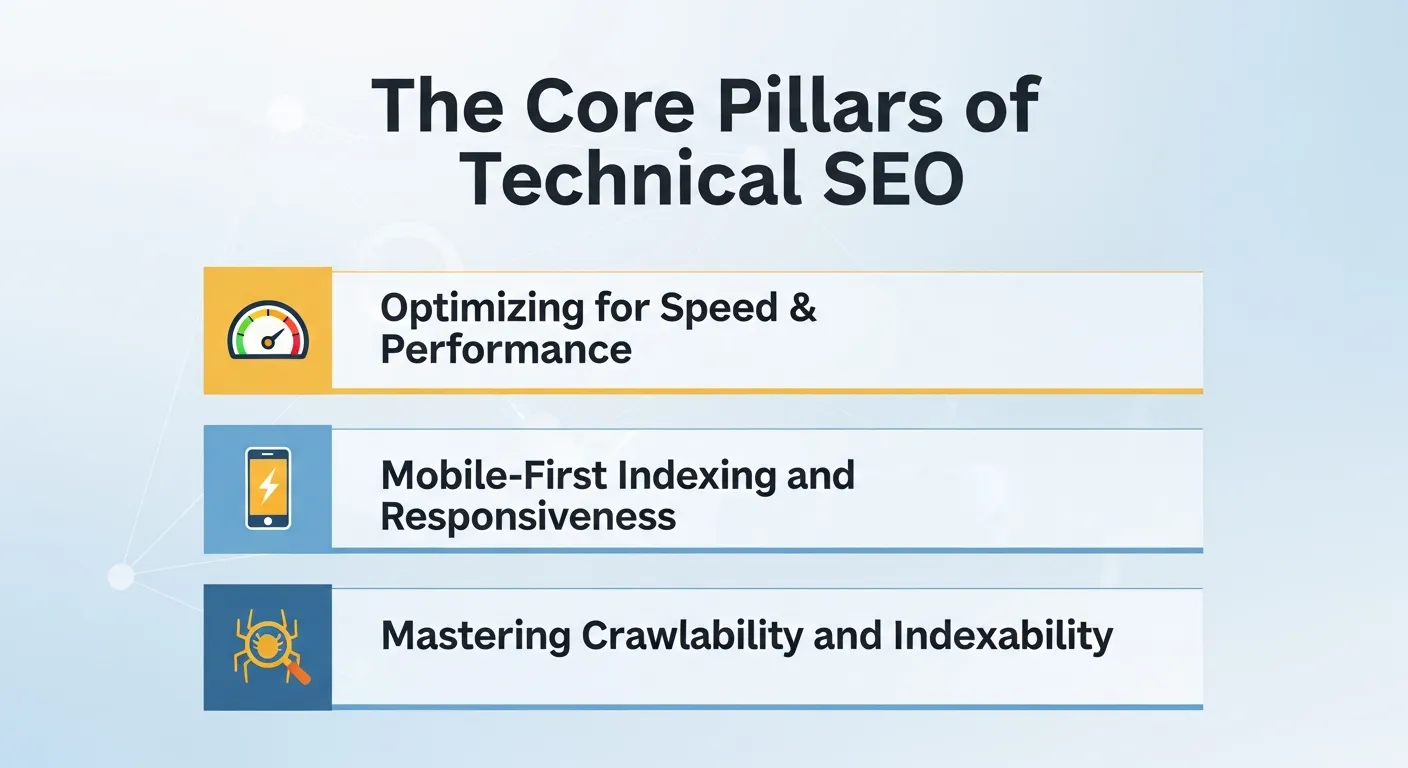
1. Optimizing for Speed and Performance
Page load time can make or break your site’s success. According to Google, the likelihood of a user bouncing increases by 32% if a page load time jumps from 1 to 3 seconds. Speed is critical—not just for user experience but also because search engines prioritize fast-loading websites.
How to Improve Blogs Page Speed:
- Minimize HTTP Requests: Combine CSS and JS files to reduce the number of “handshakes” between the server and the browser.
- Image Compression: Use tools like TinyPNG or ShortPixel.
- Browser Caching: Store static files on the user’s device so they don’t have to redownload them on every visit.
- CDN Implementation: A Content Delivery Network like Cloudflare distributes your content across global servers.
2. Mobile-First Indexing and Responsiveness
With Google’s mobile-first indexing, it’s no longer an option to have a mobile-friendly site. Your website must look and perform exceptionally well on all devices. Approximately 58% of all web traffic comes from mobile devices, making this a crucial aspect of this Ultimate Guide to Technical SEO.
To master this, you must adopt a responsive design. This ensures that your brand voice and content remain consistent whether viewed on a desktop or a smartphone. If you are looking at passive income through blogging, a mobile-broken site is a leak in your revenue bucket.
3. Mastering Crawlability and Indexability
Crawlers rely on sitemaps and a clear site structure. A poorly structured website can confuse bots, leaving key pages out of search engine indexes.
| Feature | Purpose | Action Item |
| XML Sitemap | A roadmap for crawlers | Submit to Google Search Console |
| Robots.txt | Tells bots where NOT to go | Block /wp-admin/ and private folders |
| Internal Linking | Distributes “link juice” | Link from high-authority posts to new ones |
| Breadcrumbs | Enhances navigation | Implement Schema-based breadcrumbs |
4. Structured Data and Schema Markup
Structured data, also known as schema markup, helps search engines understand the context of your pages. It is the secret sauce for winning “Rich Snippets.” Whether you are running local SEO services or a global e-commerce brand, Schema helps you stand out.
- Recipe Schema: For food bloggers.
- Review Schema: For CPG brand marketing and product reviews.
- FAQ Schema: To take up more real estate on the Search Engine Results Page (SERP).
Advanced Technical Strategies

AI and the Future of Search
As we look at how AI transforms SEO, we see the rise of Answer Engine Optimization (AEO). This involves structuring your data so that AI agents (like Gemini or ChatGPT) can easily pull answers from your site. This is a vital part of any brand strategy guide in 2026.
Security and HTTPS
Google considers HTTPS a ranking signal. Insecure sites are flagged with a “Not Secure” warning, which destroys brand perception in marketing.
-
Action: Install an SSL certificate and ensure all internal links use the
https://protocol.
Site Architecture and URL Structure
A “flat” site architecture is preferred. This means a user (and a crawler) should be able to reach any page on your site within three clicks. Use SEO-friendly URLs that are descriptive and include your focus keywords.
Technical SEO for Different Niches
While the fundamentals remain the same, certain niches require specialized technical attention:
- YouTube SEO: Focuses on metadata, closed captions, and video sitemaps.
- Amazon SEO: Prioritizes conversion rates and backend search terms.
- Ultimate Guide to Dental SEO: Focuses heavily on local schema and Google Business Profile integration.
The Role of an SEO Audit Guide
Regularly performing a technical audit is like a medical check-up for your website. Use tools like Screaming Frog or Ahrefs to find:
- Duplicate content issues.
- Broken links (404 errors).
- Redirect chains (which slow down crawlers).
- Missing Alt text for images.
Comparison of Technical SEO Tools
| Tool | Primary Use | Best For |
| Google Search Console | Indexing & Errors | Everyone (Free) |
| Ahrefs / SEMrush | Site Audit & Keywords | Professional Marketers |
| PageSpeed Insights | Performance Testing | Developers |
| Screaming Frog | Deep Crawl Analysis | Technical Specialists |
Integrating Technical SEO with Brand Strategy
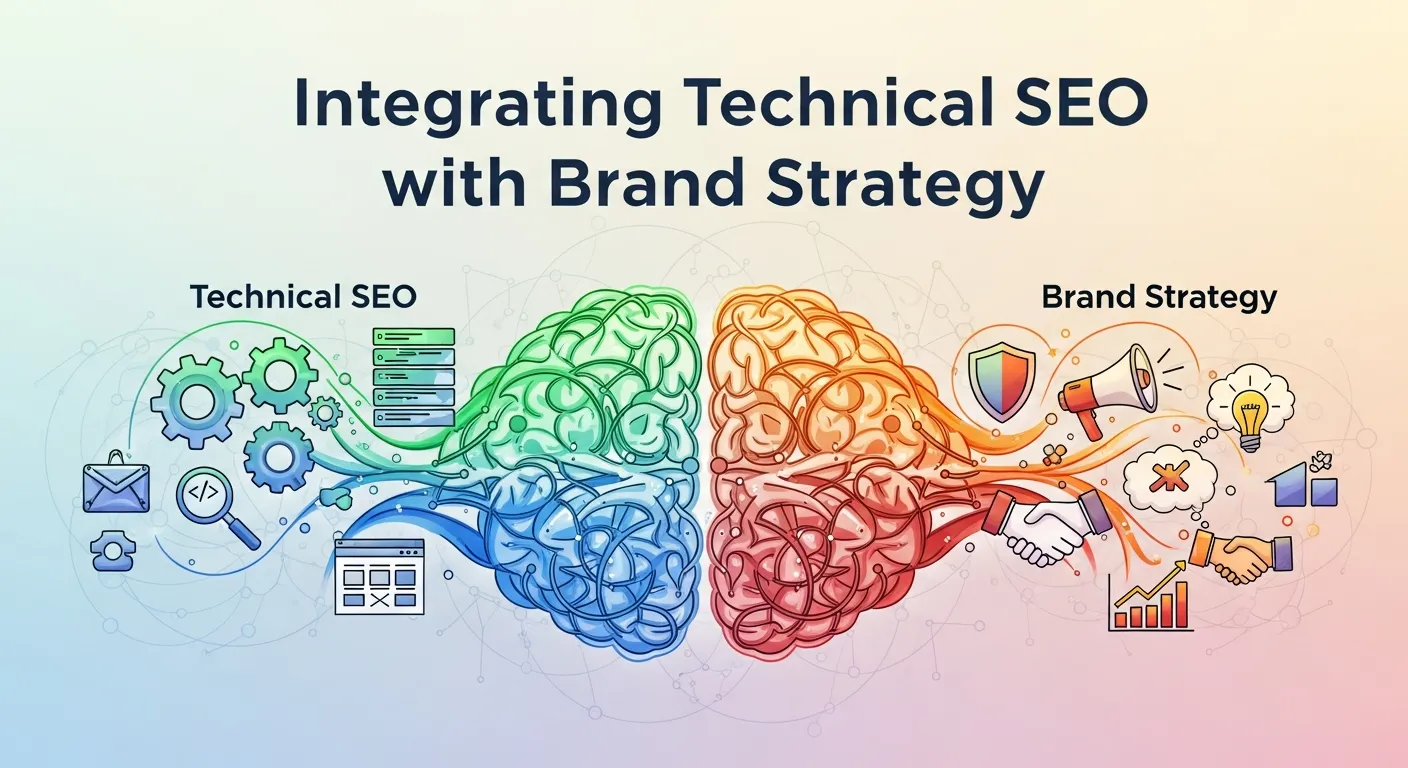
Technical SEO isn’t just a coding task; it’s a part of your brand strategy framework. If your site is slow, your brand personality comes across as outdated and unreliable. Consistency in technical performance builds brand resilience strategies that withstand algorithm updates.
If you are a startup, focusing on personal brand strategy means ensuring your name and expertise are easily findable through structured data. For larger corporations, brand architecture must be mirrored in the site’s subdirectory structure to maintain brand equity in marketing.
Answer Engine Optimization (AEO): The New Frontier
As we move further into 2026, the traditional search engine results page (SERP) is evolving into a dialogue. Answer Engine Optimization (AEO) is the practice of structuring your technical foundation so AI models like ChatGPT, Claude, and Google Gemini can easily “clip” and cite your content.
In the world of B2B digital marketing strategies, being the “cited source” in an AI summary is the new “Position Zero.” To achieve this, your site needs more than just keywords; it needs entity clarity.
- Technical Action: Use JSON-LD schema to define your brand as a specific entity.
- Strategy: Implement “Answer-First” formatting—placing a concise, 40-word summary at the top of your articles that LLMs (Large Language Models) can easily ingest.
Video SEO and Multimodal Discovery
Search is no longer just text-based. With the rise of YouTube SEO and visual search tools like Google Lens, your technical strategy must include non-text assets. AI now “watches” videos to index their content, meaning your backend metadata for video is a critical ranking factor.
To stay ahead, you must treat video as a first-class citizen in your brand strategy framework:
- Transcripts and Captions: Provide full text transcripts to help AI-driven trend forecasting tools understand your video’s context.
- Video Object Schema: Use technical markup to tell search engines the duration, thumbnail, and upload date of your media.
- Hosting Strategies: Decide between self-hosting for page speed or using third-party platforms for brand awareness.
The Synergy of UX, Core Web Vitals, and Branding
In 2026, User Experience and Branding are inseparable. Google’s Core Web Vitals have transitioned from “tie-breakers” to “gatekeepers.” If your site fails the Interaction to Next Paint (INP) metric, no amount of ethical link building will save your rankings.
| UX Metric | SEO Impact | Brand Perception |
| LCP (Loading) | High Ranking Signal | Professionalism & Speed |
| INP (Responsiveness) | Critical for Conversions | Reliability & Trust |
| CLS (Visual Stability) | Reduces Bounce Rates | Stability & Quality |
Improving your blogs’ page speed is not just a technical chore; it is a brand marketing necessity. A slow site creates a “Brand Crisis” in the mind of the user before they even read your first sentence.
Local SEO and the “Near Me” Economy
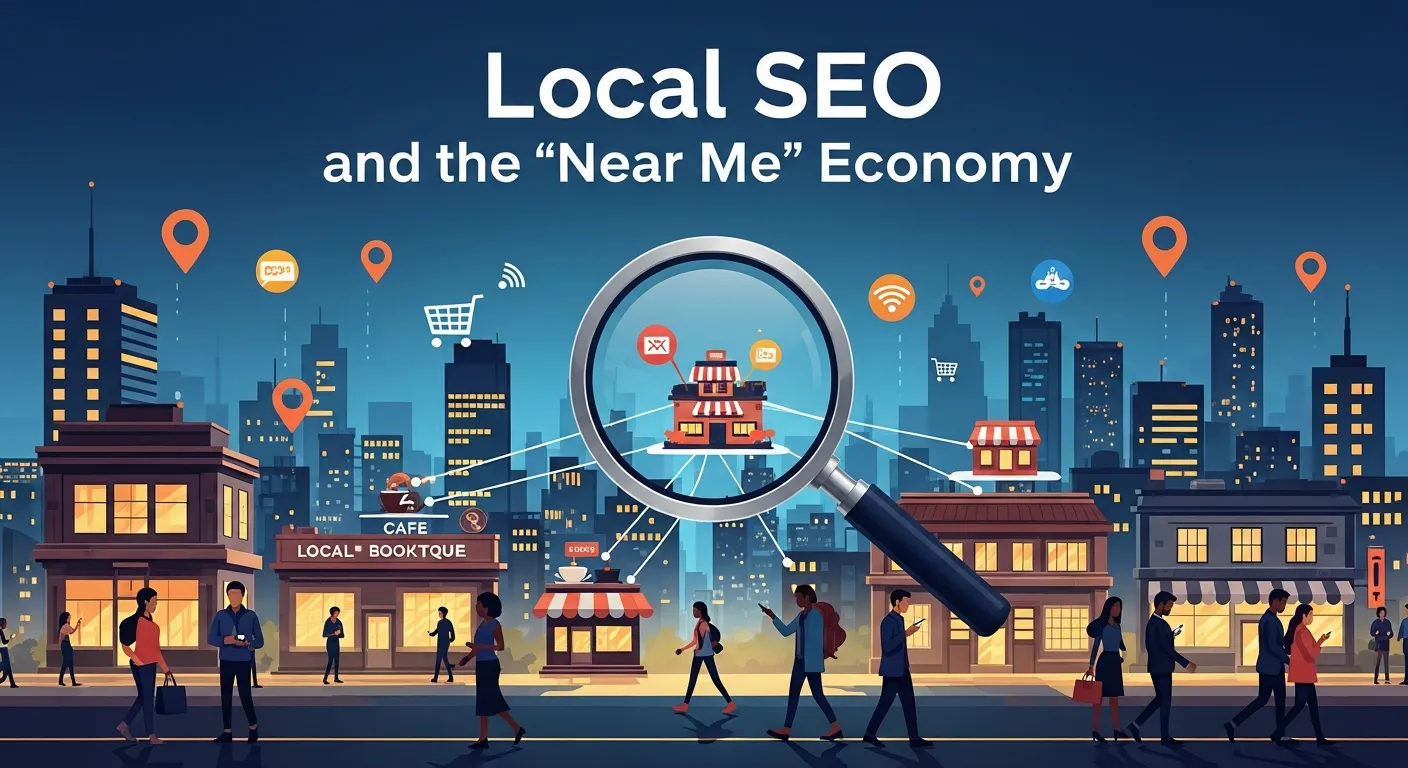
For businesses providing local SEO services, technical precision is the difference between a lead and a lost customer. Local SEO in 2026 relies heavily on GEO (Generative Engine Optimization)—optimizing so that AI assistants can recommend your physical location based on real-time data.
Smart Blogging Strategies for local brands include:
- Hyper-local Schema: Going beyond basic “LocalBusiness” markup to include “ServiceArea” and “PostalAddress” for every neighborhood you serve.
- Review Management Services: Technically integrating your Google Business Profile reviews directly onto your site to build brand authority.
Ethical SEO and Reputation Management
In an era of deepfakes and mass-produced AI content, reputation management has become a technical discipline. Search engines now prioritize “provenance”—the ability to track content back to a human expert.
This is where Personal Reputation Management and Brand Monitoring Services intersect with SEO. By using technical “Rel=Author” tags and linking to verified social profiles, you satisfy the “Experience” and “Trust” pillars of E-E-A-T. This ensures your personal brand strategy remains resilient against AI-generated competitors.
Future Opportunities: SEO in the 2030s
As we look beyond the current horizon, several game-changing advantages are emerging for those who master the Ultimate Guide to Technical SEO.
The Rise of Agentic AI Commerce
We are entering the era of “Agentic SEO.” Soon, users won’t search for products; their AI agents will search for them. Future technical SEO will involve optimizing your site’s API and database accessibility so that an AI agent can not only find your product but also execute a transaction using digital payment solutions.
6G and Edge Computing
With the upcoming rollout of 6G, the definition of “fast” will change again. Edge computing will allow websites to “render” closer to the user, making global brand consistency easier to maintain but requiring a more complex, decentralized technical setup.
Sensory and Sonic Branding
As voice-first devices become the primary way we interact with the web, Sonic Branding (the technical use of unique audio identifiers) will become a searchable attribute. Optimizing for “how your brand sounds” will be as important as “how it looks.”
Conclusion
Technical SEO might not be the most glamorous side of search engine optimization, but it’s undeniably essential for long-term success. By addressing speed, mobile responsiveness, and crawlability, you create a solid foundation that allows your content to shine. Commit to these smart blogging strategies today to ensure your website remains competitive in the ever-evolving digital marketplace.
Frequently Asked Questions (FAQs)
1. What is the difference between On-Page and Technical SEO?
On-page SEO focuses on the content and keywords visible to users. Technical SEO focuses on the backend infrastructure, like site speed, mobile-friendliness, and indexing, which helps search engines crawl the site.
2. How often should I conduct a technical SEO audit?
For most sites, a comprehensive audit every quarter is sufficient. However, if you have a large e-commerce site with frequent updates, monthly checks are recommended to catch broken links or crawl errors early.
3. Does hosting affect my technical SEO?
Yes. High-quality hosting improves server response times (TTFB), which is a key component of page speed. Poor hosting can lead to frequent downtime, preventing search engines from crawling your site.
4. What are Core Web Vitals?
Core Web Vitals are a set of specific factors that Google considers important in a webpage’s overall user experience. They include Largest Contentful Paint (loading), First Input Delay (interactivity), and Cumulative Layout Shift (visual stability).
5. Can I do technical SEO myself?
Basic tasks like optimizing images and using plugins for sitemaps are doable for beginners. However, complex issues like fixing redirect loops or implementing advanced Schema often require a developer or a digital marketing expert.
6. Is HTTPS really that important for SEO?
Absolutely. Beyond being a ranking signal, it protects user data and builds trust. Most modern browsers will warn users before entering an HTTP site, leading to a massive drop in traffic.
7. How do I fix a “Crawl Budget” issue?
Crawl budget refers to the number of pages a bot crawls on your site in a specific timeframe. You can optimize this by removing duplicate content, fixing broken links, and using robots.txt to block low-value pages.
8. What is the impact of AI on technical SEO?
AI is making search engines smarter at understanding site structure. This means technical SEO is shifting toward Answer Engine Optimization, where the goal is to provide clear, structured data that AI can interpret instantly.
9. How does mobile-first indexing work?
Google predominantly uses the mobile version of a site’s content for indexing and ranking. If your desktop site is perfect but your mobile site is lacking, your rankings will suffer across the board.
10. What is a 301 redirect and when should I use it?
A 301 redirect is a permanent redirect from one URL to another. Use it when you delete a page or move content to a new URL to ensure you don’t lose the “link juice” and ranking power of the original page.