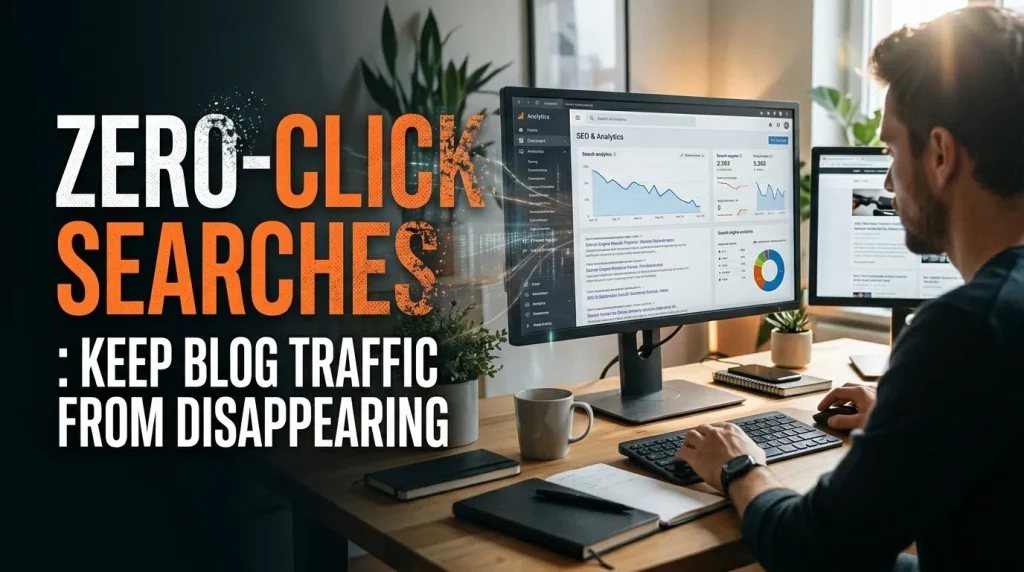
Zero-Click Searches : Keep Blog Traffic From Disappearing
Zero-Click Search changes how people discover information today, but blogs can protect growth by earning visibility, building trust, and giving readers stronger reasons to visit.
A person can discover an idea, read a short answer, compare basic facts, and make a small decision without opening a website. That is the challenge behind Zero-Click Search. Search engines increasingly place direct answers, featured snippets, local information, calculators, product details, and AI-generated summaries on the results page. The searcher receives information, while the publisher may receive an impression without a visit.
For blog owners, this creates a confusing situation. Rankings can remain stable while sessions decline. Impressions can rise while clicks stay flat. A useful article may influence a decision even when analytics cannot record a visit. Treating every unclicked impression as a failure can lead to poor choices: hiding answers, targeting unrelated keywords, or making articles longer without adding value.
The better response is to understand which needs can be completed directly on a results page and which still require deeper help. Zero-Click Search does not make every blog visit unnecessary. It changes the moment when a visit becomes valuable. A definition may satisfy one reader, while another needs a framework, example, comparison, template, or trusted recommendation before acting.
A resilient blog therefore has two connected goals: become easy to understand wherever people search, and make the website itself worth visiting. That requires sharper intent research, original value, clear information architecture, consistent brand recognition, and measurement that looks beyond raw sessions. The goal is not to force every searcher to click. It is to earn the right click from people who need more than a short answer.
What Zero-Click Search Means for Modern Blogs
Zero-Click Search describes a search journey in which a person receives the information they wanted directly from a search results page or an integrated search experience without clicking through to an external website. The answer may appear in a featured snippet, knowledge panel, calculator, local result, People Also Ask response, AI-generated summary, or another search feature.
The term describes user behaviour, not a ranking penalty. A page can appear prominently and still receive fewer visits than its impression count suggests. The effect varies by subject, device, location, query wording, and search layout. A search for a simple date, definition, conversion, or opening time may be easy to complete without a visit. A search involving a complicated purchase, professional decision, detailed comparison, or personal problem creates more reasons to continue researching.
Zero-Click Search does not mean every results page is now an answer box. Traditional organic listings, advertisements, images, videos, local results, discussion content, and AI features can appear together. Their positions and formats vary according to the query. Publishers should study actual results for their own topics rather than assume that one broad industry statistic describes every keyword.
Search Features That May Complete a Task Without a Click
| Search feature | What the user receives | Possible blog impact |
|---|---|---|
| Featured snippet | A short answer, list, or explanation | More visibility, but fewer visits for simple questions |
| AI Overview or AI answer | A generated summary with supporting links | The first research step may happen before a visit |
| Knowledge panel | Key facts about an entity or organisation | Basic factual searches may end on the results page |
| People Also Ask | Expandable answers to related questions | Users may resolve several small questions without a visit |
| Calculator or conversion tool | An immediate numerical result | Utility pages may lose visits when the task is completed instantly |
| Local results | Business details, hours, directions, and reviews | Users may call or visit without opening a blog |
| Video or image preview | A visual explanation or demonstration | Some users may consume enough information in search |
These features are not automatically harmful. They can introduce a brand to new audiences, validate expertise, and help users discover a source they may visit later. Zero-Click Search becomes a commercial problem when a blog depends heavily on basic informational impressions but provides no clear path from awareness to deeper engagement.
Why Zero-Click Searches Are Changing Blog Traffic
Search platforms are designed to reduce effort. When a person asks a straightforward question, an immediate answer can be more useful than requiring several clicks. Search experiences also help people explore complicated subjects through summaries and supporting sources. For publishers, the value of a page is no longer reflected only in the number of people who open it.
Basic Questions Can Be Answered Immediately
A short factual query often has a predictable answer. A reader searching for a definition may need one sentence. Someone looking for a date or a simple calculation may need one result. When a search interface provides that information clearly, the user may have little reason to visit another page.
A blog that publishes many short answers without additional context is more exposed to Zero-Click Search. The solution is not to hide the definition. It is to provide the direct answer and make the next layer of value clear. A definition page can explain when the term matters, where it is misunderstood, and how it connects to a real decision.
For example, an article about customer acquisition cost should define the metric, show the formula, explain which expenses belong in it, and demonstrate how different business models affect interpretation. The definition may satisfy a quick query. The worked example and decision-making guidance give the reader a reason to visit.
AI Search Changes the Research Journey
AI features can summarise information, connect related subtopics, and provide links for further exploration. Google explains that AI Overviews and AI Mode use links to help people explore information, and that established SEO fundamentals remain relevant. It also states that pages must meet normal technical requirements and be eligible to appear with a snippet to qualify as supporting links in those features. The official AI features and your website guidance is useful for understanding these requirements.
This creates a layered journey. One user may see a summary, recognise a brand, open a supporting page, and explore another resource. Another may finish the initial task without clicking. Zero-Click Search should be analysed as part of a broader discovery journey rather than a simple contest between AI answers and websites.
Mobile Convenience Changes Expectations
Mobile users often search while travelling, shopping, working, or comparing something in the moment. They may want a quick answer and have little time to read a long article. Features that display information directly can be particularly convenient in these situations.
A publisher should not respond by making mobile pages longer or more complicated. The first screen should communicate the page’s purpose quickly. Readers who need detail should be able to reach it through descriptive headings, readable paragraphs, jump links, useful tables, and clear next steps. A mobile visitor should never have to fight the layout to find the information promised in the search result.
Search Intent Determines How Much Traffic Is Exposed
Not every informational keyword behaves alike. A simple definition, a troubleshooting query, and a strategic question may all be informational, but they demand different levels of effort. Zero-Click Search is more likely to complete a task when the task is narrow and the answer is stable. It is less likely to satisfy someone who must judge evidence, weigh trade-offs, or apply advice to a specific situation.
A useful content plan starts with intent rather than search volume alone. A deeper explanation of Search Intent for Blogs can help separate quick-answer queries from research-heavy needs. When content matches the actual problem, a page has a stronger chance of earning a visit from readers who need meaningful help.
Which Blog Topics Are Most Exposed?
A practical risk assessment is better than assuming every page will lose the same percentage of traffic. Zero-Click Search risk depends on how easily the main need can be satisfied without the page, how much original value the page provides, and whether the searcher has a reason to continue.
High-Risk Topics: Simple Answers and One-Step Tasks
Pages that mainly provide a short definition, basic fact, single conversion, or simple list may be more exposed. If the search result already gives the answer, the user may not need the full article. This does not mean these pages should be deleted. They can support topical coverage, internal navigation, and brand awareness, and may help readers discover deeper resources.
Review these pages for opportunities to add context that genuinely helps. A definition page could explain when the term matters and what mistakes people make. A list page could include selection criteria, limitations, or a practical comparison. Do not add filler just to increase length. The additional material must solve a real follow-up problem.
Medium-Risk Topics: Comparisons and How-To Guides
Comparison articles and tutorials may lose introductory clicks when search features summarise the first few steps. However, their full value often depends on details that cannot be compressed into a small answer. Readers may need screenshots, decision criteria, examples, trade-offs, troubleshooting, or advice based on their own situation.
A useful tutorial should explain what to do, why each step matters, what can go wrong, how to verify the result, and when an alternative is more appropriate. In this context, Zero-Click Search can act as an awareness layer while the article remains the place where a reader completes the harder task.
Lower-Risk Opportunities: Original Insight and High-Consideration Decisions
Original research, first-hand testing, detailed case studies, proprietary frameworks, expert commentary, and complex evaluations give readers stronger reasons to visit the source. A short summary may communicate a conclusion, but it cannot reproduce the full evidence, methodology, context, or tools.
Lower risk does not mean immune. A search feature can still reduce clicks for a page containing unique information. The strategic advantage is that original work is harder to replace with a generic answer. It can also make a brand memorable, attract references from other sites, and support later direct or branded searches.
| Topic type | Relative exposure | Why | Best response |
|---|---|---|---|
| Basic definition | High | The answer is short and easy to display | Add context, examples, and related concepts |
| Simple fact or date | High | A direct result may complete the task | Keep it accurate and connect it to a useful resource |
| Basic checklist | Medium to high | A short list may be enough for some users | Add criteria, prioritisation, and interpretation |
| Detailed tutorial | Medium | Users may need the complete process | Provide steps, examples, checks, and troubleshooting |
| Product comparison | Medium | A summary cannot resolve every trade-off | Explain methodology, use cases, and limitations |
| Original research | Lower relative exposure | Readers may need evidence and methodology | Publish data and explain methods |
| Case study | Lower relative exposure | Context and implementation details matter | Show the process, decisions, results, and limitations |
How to Audit Zero-Click Risk Across Existing Content
An audit identifies where traffic changes are occurring and which pages deserve attention first. Zero-Click Search should be investigated with page-level and query-level evidence, not judged from total website sessions alone.
Start With Search Console Data
Open Google Search Console and review the Performance report for Web search. Compare a meaningful period with a previous period of similar length. Check clicks, impressions, click-through rate, and average position. Segment the data by page and query so that a change in one group does not hide a different pattern.
Look for pages with stable or rising impressions but falling clicks. This pattern may indicate a lower click-through rate, a changed results-page layout, altered intent, stronger competition, a title mismatch, or more answer features. It does not prove that Zero-Click Search is the only cause. A drop in average position, seasonal demand, or a competitor’s stronger result may explain the decline instead.
Google states that traffic from its AI search features is included in the overall Search Console Performance reporting under the Web search type. Publishers should therefore interpret the report carefully and combine it with analytics and conversion data rather than expect a separate universal AI traffic figure.
Compare Queries With Similar Intent
A broad page may rank for dozens or hundreds of queries. Some may be answerable in one sentence, while others signal a reader who wants to research a decision. Group queries by the need behind them, then compare click patterns within each group.
For instance, a guide about email deliverability might rank for “what is email deliverability,” “email deliverability checklist,” and “how to fix low inbox placement.” The first query may be satisfied by a quick explanation. The others suggest a need for a process, diagnosis, or operational detail. Treating them as one traffic pattern can hide valuable opportunities.
Inspect the Live Search Results Page
Search the target query in the relevant country, language, and device context. Record what appears above organic listings, whether AI summaries are present, which formats dominate, and what the leading pages offer. Repeat the check for several important queries because layouts can differ even within one topic.
Do not rely on one screenshot taken once. Search features can change, and results may vary by location, device, and query wording. The aim is to identify a repeated pattern, not to overreact to a temporary layout.
Review Analytics and Business Outcomes
Connect search landing pages to meaningful events: newsletter subscriptions, demo requests, product views, downloads, contact forms, purchases, or assisted conversions. A decline in sessions may matter less if qualified leads and revenue remain stable. On the other hand, a small traffic decline can be serious when the lost visits came from high-intent readers.
| Metric | What it tells you | What it cannot prove alone |
|---|---|---|
| Impressions | How often a page appeared in search | Whether people noticed or trusted the result |
| Clicks | Visits from search results | The full influence of search visibility |
| Click-through rate | The share of impressions that generated clicks | Why people did not click |
| Average position | A broad view of ranking performance | The full layout or visual prominence |
| Engaged sessions | Whether visitors interacted meaningfully | Whether non-visitors were influenced |
| Conversions | Whether traffic produced business outcomes | The full contribution of earlier discovery |
| Branded search growth | Whether more people search for the brand | Which channel created the awareness |
Build Content That Offers More Than a Direct Answer
The sustainable response is to make the website valuable after the searcher understands the basic answer. Zero-Click Search rewards clarity at the discovery stage, but deeper usefulness gives readers a reason to continue.
Give the Direct Answer, Then Expand the Value
Start important sections with a concise response to the question. This helps readers and search systems understand the subject quickly. Then add the context that makes the answer useful: conditions, exceptions, examples, risks, and next steps.
Do not deliberately withhold a simple answer to force a click. Readers recognise evasive writing, and it damages trust. Instead, make the first answer genuinely helpful and make the rest of the page genuinely useful for people with a deeper problem. In a Zero-Click Search environment, clarity is not the enemy of traffic; it is the foundation of a credible result.
Add First-Hand Examples and Practical Interpretation
Generic advice is easy to summarise. A specific example can reveal the reasoning behind a recommendation. Explain the starting situation, the constraint, the decision, the action, the result, and what the result does not prove.
For example, do not merely say that a business should improve its landing page. Show how a confusing offer, weak proof, or unclear form creates friction. Explain which change was tested, how performance was measured, and what a different business should consider before copying the approach. That detail gives a reader a reason to visit even when Zero-Click Search displays a short summary.
Publish Original Data and Transparent Methods
If you conduct surveys, analyse campaign results, test tools, or review a dataset, document how the work was completed. Include the sample, time period, definitions, exclusions, and limitations. Original research can support citations and brand authority, but only when the methodology is transparent and claims are proportionate to the evidence.
Do not present a small sample as a universal industry truth. A clear limitation often makes a finding more useful because readers can judge whether it applies to their own circumstances. Distinctive evidence is one of the strongest ways to make a page worth opening after a Zero-Click Search impression.
Create Decision Tools, Templates, and Worksheets
Interactive or downloadable resources create practical value beyond a short summary. Examples include a content audit worksheet, campaign planning template, cost calculator, evaluation checklist, or implementation tracker. These assets should solve a genuine task and work properly on mobile devices.
A tool does not have to be technically complex. A well-designed worksheet with clear instructions can save time and help a reader move from understanding to action. Explain what information it collects, how to use it, and what decisions it can support. A useful resource gives people a concrete reason to move from a Zero-Click Search result to your website.
Include Expert Judgement and Meaningful Trade-Offs
Readers often need help choosing between reasonable alternatives. Explain when one approach is suitable, when another is better, and what constraints influence the decision. Do not label one method universally best when the answer depends on budget, team capacity, risk tolerance, audience, or business model.
This kind of interpretation can make Zero-Click Search a starting point rather than the end of the journey. A brief answer may tell a reader what an option is. Your article should help them decide whether it is right for them, what to evaluate, and what to do next.
Optimise Search Presentation Without Sacrificing the Click
Search presentation matters because users decide whether to click before they reach the page. The title, snippet, URL, brand familiarity, and visible promise shape that decision.
Write Titles That Communicate a Specific Benefit
A good title is clear, accurate, and distinctive. It should explain what the page helps the reader do, not merely repeat a generic keyword. Avoid exaggerated claims that the content cannot support. If the page offers a framework, comparison, or tested process, communicate that value honestly.
Google may generate title links using several signals, including the page title, visible heading, prominent text, and references from other pages. Publishers can provide clear signals but cannot guarantee that a search engine will display a chosen title exactly. Keep the title and on-page heading consistent in meaning, even when their wording differs slightly. This matters when Zero-Click Search features compete for attention above traditional listings.
Create Useful Meta Descriptions
A meta description should give searchers a concise reason to choose the page. Focus on the problem solved, the audience served, and the value that makes the page distinct. Avoid a string of keywords or a vague promise such as “everything you need to know.”
Google primarily generates snippets from page content and may use a meta description when it provides a better summary for a particular query. It can also show different snippets for different searches. Read Google’s snippet guidance before making broad changes to preview controls. A well-written description can help set expectations, but it cannot guarantee a click from every Zero-Click Search result.
Make the First Screen Earn Attention
The first visible section should confirm that the reader has arrived at the right place. Include a direct introduction, a clear heading structure, and a quick explanation of what the page will deliver. Avoid large blocks of unrelated text, intrusive overlays, or an opening that delays the answer.
Do not make every page look like a sales landing page. Informational visitors need confidence that the article will help them. A clear promise and a well-organised opening create that confidence without distracting users who have chosen to leave the results page and read more.
Use Structured Data Only When It Fits Visible Content
Structured data can help search engines understand eligible page information and may support certain rich-result experiences. It is not a guarantee of enhanced visibility, and it should accurately reflect content that users can see. Never add unsupported ratings, reviews, prices, author credentials, or FAQ content simply to chase a feature.
Google’s documentation lists the structured-data features it supports and explains the requirement to follow its guidelines. Validate markup, keep it current, and remove elements that no longer match the visible page. Do not confuse structured data with a way to force a featured snippet or an AI citation. A good Zero-Click Search strategy depends on useful content first, not markup tricks.
Strengthen Brand Demand So Readers Look for You Directly
Search visibility is valuable, but a business should not depend entirely on a single results page. A recognised brand gives readers a reason to search for the publisher by name, return directly, subscribe, or recommend a resource.
Make Your Editorial Identity Consistent
Choose a clear subject area and explain what the publication helps its audience achieve. Consistent positioning across articles, author biographies, about pages, and social profiles helps readers understand why the site is worth remembering.
A broad blog can cover several subjects, but each topic cluster should have a coherent audience and purpose. Publishing disconnected articles merely because a keyword has volume can weaken the site’s identity. Readers are more likely to remember a source that repeatedly solves related problems with a recognisable point of view. Brand familiarity can also help a person who first encountered the site through Zero-Click Search recognise it later.
Build Relationships Beyond Search
Email newsletters, communities, professional networks, social channels, and relevant partnerships provide ways to reconnect with readers. These channels should offer genuine value rather than repeat article links without context. A useful newsletter might explain one practical lesson, share a new finding, or provide a resource that helps a reader complete a task.
A stronger distribution mix reduces dependence on any one search feature. It also allows a publisher to reach people who discovered an article through Zero-Click Search but did not visit at that moment. Brand familiarity may influence a later search, referral, or direct visit.
Make the Brand Worth Searching For
A distinctive research series, useful toolkit, expert newsletter, or recognisable editorial framework can create demand beyond individual keywords. Give these assets clear names and consistent presentation. Make it easy for people to understand what they will receive and why it is credible.
Brand building is not a substitute for useful content. It is the result of repeatedly delivering useful content and a dependable experience. When people remember the source, the relationship can continue beyond a single Zero-Click Search session.
Use Internal Links to Move Readers Toward Deeper Answers
Internal links connect related pages and give readers a natural route through a topic. They also help search engines discover relationships between pages. For Zero-Click Search resilience, links should lead from a basic explanation to a resource that answers the next logical question.
Link According to the Reader’s Next Need
A link should appear where the reader is likely to need the next piece of information. If an article explains a search visibility problem, a related guide to AI Search Optimization can help readers understand how to prepare content for evolving search experiences. The link belongs in a paragraph that establishes that connection, not in an unrelated section or a keyword list.
Use descriptive anchor text that tells readers what they will find. Avoid generic anchors such as “click here” when a clearer phrase is available. Do not add a link merely because a phrase can be linked. The destination should provide meaningful continuation. A well-placed link turns a Zero-Click Search discovery into a guided content journey when the reader wants more detail.
Build Topic Clusters With Clear Roles
A topic cluster should not contain multiple pages that compete to answer the same question. Give each page a distinct purpose. One page may define a concept, another may provide a practical workflow, and another may compare tools or explain measurement. Link them together when their relationship is useful.
This helps a visitor move from awareness to evaluation and implementation. It also reduces the chance that several pages on the same site repeat the same shallow explanation without adding new value. Clear page roles make internal links more useful to readers arriving after a Zero-Click Search result.
Use Commercial Links Only When the Context Is Relevant
Informational content can naturally lead to commercial resources when the reader reaches a decision point. For instance, a discussion of bidding strategy may point to Value-Based Bidding when the article explains how businesses can prioritise outcomes rather than volume alone. That link should support the paragraph’s meaning and remain useful even if the reader does not click immediately.
Likewise, a discussion of channel selection may connect to Google Demand Gen vs Search when the reader needs to compare discovery-led and intent-led advertising. Relevant internal links strengthen the content journey; unrelated links interrupt it. The goal is to give a Zero-Click Search visitor a useful next step, not to force a commercial message into every section.
Improve Conversion Paths Without Turning Every Article Into an Advertisement
A visitor who reaches a blog should be able to take a logical next step. That does not mean every paragraph needs a call to action. Too many banners, pop-ups, and competing buttons can make a helpful article feel like a sales pitch.
Match the Call to Action to Intent
A reader who is learning a concept may prefer a related guide or newsletter. Someone comparing solutions may want a product evaluation checklist or case study. A reader who is ready to act may need a consultation, demo, quote, or purchase option.
Create a simple content-to-action map. Identify the reader’s likely stage, the next question they may ask, and the most useful action to offer. This makes the page more persuasive without applying pressure. A Zero-Click Search impression may create awareness, but the landing page should make the next step natural for the visitors who arrive.
Use Proof That Reduces Real Doubt
Testimonials, case studies, relevant credentials, transparent methodology, and clear policies can help readers evaluate credibility. Proof should be specific and verifiable. A statement such as “we deliver exceptional results” is weaker than a case study that explains the starting challenge, the intervention, the measurement period, and the outcome.
Do not promise guaranteed rankings, traffic, revenue, or AI citations. Search systems and user behaviour involve variables a publisher cannot control. Honest expectations build more durable trust than exaggerated certainty, especially when Zero-Click Search results already expose readers to multiple competing sources.
Make Forms and Next Steps Easy to Complete
Keep forms proportionate to the value being offered. A newsletter should not require unnecessary personal information. A consultation form should request details that help the conversation, not every possible business metric. Make buttons descriptive, ensure pages load reliably, and confirm what happens after submission.
Track completed actions rather than button clicks alone. A button may receive attention but lead to a form that users abandon. Understanding the full path reveals whether a page is converting interest into meaningful engagement. This allows a team to judge Zero-Click Search traffic by its quality rather than its volume alone.
Measure Success Beyond Organic Clicks
Organic traffic remains important, but it is not a complete description of search performance. A resilient reporting model includes visibility, engagement, audience growth, brand demand, and commercial outcomes.
Track Metrics That Explain the Journey
Use a small dashboard that answers practical questions. Are important pages still appearing? Are relevant visitors clicking? Are readers engaging with content? Are more people searching for the brand? Are leads, subscriptions, or sales improving?
| Measurement area | Useful metrics | Why it matters |
|---|---|---|
| Search visibility | Impressions, queries, average position | Shows whether content remains discoverable |
| Search engagement | Clicks, click-through rate, landing-page mix | Shows whether previews motivate visits |
| On-site value | Engaged sessions, scroll depth, return visits | Indicates whether visitors find useful content |
| Audience ownership | Email subscribers, repeat users, community growth | Builds ways to reach readers beyond search |
| Brand demand | Branded queries, direct visits, referral mentions | Shows whether awareness extends beyond generic keywords |
| Business impact | Qualified leads, assisted conversions, revenue | Connects content to outcomes that matter |
Compare Performance by Query Group
Separate quick-answer queries from research, comparison, troubleshooting, and commercial-investigation queries. This makes it easier to identify where click loss is concentrated. A page can experience fewer clicks for simple definitions while still gaining valuable visits from specific queries.
Do not combine unrelated periods or compare a seasonal month with a naturally stronger period without adjustment. Consider country, device, branded versus non-branded queries, and changes in the results page. The aim is a credible explanation, not a convenient story. A Zero-Click Search analysis should reveal which audience needs have changed and which page opportunities remain.
Measure Assisted Conversions and Returning Behaviour
A person may see a brand in search, leave without clicking, and return later through a branded query, email, referral, or direct visit. Standard last-click reporting may not show the full influence of that first discovery. Use available analytics carefully, and avoid claiming attribution where the evidence is incomplete.
Track returning visitors, subscriber growth, branded search trends, and assisted conversions where the data supports them. These indicators can reveal whether search visibility contributes to demand even when an immediate session does not occur. This broader view is essential when assessing Zero-Click Search impact on a business rather than a single analytics column.
Build a Practical Reporting Rhythm
A monthly review is often enough for stable content portfolios, while rapidly changing topics may need more frequent checks. Use a consistent template: pages with rising impressions and falling clicks, pages losing ranking positions, pages producing qualified conversions, pages with outdated information, and pages that need new supporting resources.
Record the action taken and the reason. If you change a title, update a page, improve internal links, or add a resource, compare the next period with the original baseline. Avoid changing several major elements at once when you need to understand which action influenced the outcome. Review updates against the baseline before making a major editorial change to the page.
Common Mistakes That Make Traffic Loss Worse
A poor reaction can damage the experience that made a blog valuable in the first place. Zero-Click Search requires deliberate adaptation, not panic.
Hiding the Answer to Force a Visit
Withholding a simple answer may appear to protect clicks, but it frustrates users and weakens trust. Answer the question directly, then explain what the short answer leaves unresolved. A reader who gets immediate value is more likely to trust the deeper guidance.
Adding Words Without Adding Insight
Longer content is not automatically more useful. Repeating the same keyword, restating obvious points, and adding generic paragraphs can make an article harder to navigate. Each section should contribute a distinct explanation, example, decision, or action. Avoid turning Zero-Click Search optimisation into a word-count exercise that sacrifices clarity.
Treating Every Impression as a Lost Customer
Some impressions come from users who only need a brief fact. Others introduce a brand to a future buyer. Zero-Click Search should be evaluated against the value of the query and the likely next step, not by treating every unclicked result as a failed visit.
Blocking Search Previews Without a Clear Reason
Search preview controls can affect how a page appears. Google documents controls such as nosnippet, max-snippet, and data-nosnippet, but limiting snippets can also reduce the information displayed for a result. Before changing these settings, test the expected impact and understand what visibility or eligibility may be affected.
Do not block previews simply because an answer feature exists. A snippet can help a searcher understand relevance and choose the source. Preview restrictions are technical decisions with trade-offs, not a universal traffic-recovery tactic. A careful Zero-Click Search strategy weighs the benefit of controlling previews against the risk of reducing useful visibility.
Chasing AI Mentions Instead of Serving Readers
A publisher should make content easy to crawl, clear to interpret, and useful to cite. It should not create awkward text solely to appear in an AI response. Google’s documentation says there are no additional special optimisations or machine-readable files required for AI Overviews or AI Mode beyond established SEO foundations. Focus on accessibility, helpful information, sound technical implementation, and original value.
Ignoring Content Accuracy and Freshness
Outdated prices, unsupported claims, broken links, and obsolete screenshots reduce trust. Review pages when the subject changes, when examples stop matching a product, or when analytics show that the page no longer satisfies the query. Update the substance, not just the publication date. Accuracy is especially important when a Zero-Click Search answer may quote or summarise a small part of your content.
A 90-Day Action Plan to Protect Blog Traffic
A structured plan helps teams prioritise changes without trying to rewrite the entire website at once. The following framework can be adapted to a small blog or a larger publication.
Days 1–30: Diagnose and Prioritise
Start with the pages that matter most to the business. Identify important landing pages, compare current and previous search performance, and group queries by intent. Review the live results page for valuable queries. Check whether the page still matches the question and whether competitors provide a more compelling reason to click.
Create three groups: pages that need technical correction, pages that need a stronger user experience, and pages that need more original value. Prioritise based on potential business impact, not simply the highest impression count. Record a baseline for clicks, engagement, conversions, and branded demand. Use this baseline to judge later changes in Zero-Click Search visibility and website performance.
Days 31–60: Improve the Most Valuable Pages
Rewrite vague titles, improve introductions, and make section headings more descriptive. Add examples, original analysis, comparison criteria, and troubleshooting where these improve the page. Review internal links and connect related articles according to the reader’s next need.
Improve mobile readability, page speed, navigation, and calls to action. Add structured data only where the content qualifies and the markup reflects what users can see. Validate important technical changes and make sure search engines can access the content. The aim is not merely to gain a Zero-Click Search mention; it is to create a page that deserves attention and delivers value after the visit.
Days 61–90: Expand Value and Measure Results
Publish supporting articles that answer distinct follow-up questions. Develop one reusable resource such as a checklist, calculator, worksheet, or original research summary. Promote the strongest insight through the newsletter and relevant professional channels. Make brand and author information consistent.
At the end of the period, compare results with the baseline. Look for changes in query mix, click-through rate, qualified engagement, conversions, branded searches, and returning visitors. Keep improvements that deliver value, revise those that do not, and document what the data cannot establish.
| Period | Primary objective | Core actions | Evidence of progress |
|---|---|---|---|
| Days 1–30 | Understand the risk | Audit queries, pages, search results, and conversions | A prioritised page list and reliable baseline |
| Days 31–60 | Improve page value | Refresh content, titles, internal links, UX, and calls to action | Better relevance, engagement, and clearer next steps |
| Days 61–90 | Build resilience | Publish original assets, distribute content, and review outcomes | Stronger audience relationships and measurable business contribution |
The Long-Term Strategy: Make Every Search Impression More Valuable
The most effective response is not to win every possible click. It is to make each appearance contribute to a larger relationship. A reader may discover your brand through a short answer, recognise your name in a later comparison, subscribe after reading a detailed guide, or return when a more urgent need appears.
To support that journey, maintain a clear editorial position, publish information that reflects real expertise, and make your website easy to use. Keep technical SEO sound, make important information accessible in text, and connect related resources with helpful internal links. Review search performance alongside audience and business metrics so traffic changes lead to informed decisions.
Zero-Click Search is a reason to improve the value of content, not abandon the purpose of blogging. A blog that only repeats information may struggle to earn visits. A blog that helps people understand, evaluate, decide, and act can remain useful even as search interfaces change.
Conclusion
Zero-Click Search changes how people discover information, but it does not remove the need for expert guidance, original insight, or trusted websites. Blog owners should identify queries that can be answered instantly, strengthen pages that solve deeper problems, and measure visibility alongside engagement and conversions. Clear titles, useful introductions, internal links, practical resources, and consistent brand building create reasons to visit. Do not hide answers or add empty text to chase clicks. Give readers value immediately, then make the next step worthwhile. Sustainable traffic comes from serving real needs throughout the search journey. Search experiences continue to change over time.
Frequently Asked Questions (FAQ)
What is Zero-Click Search in SEO?
Zero-Click Search happens when a person receives the information they wanted directly from a search results page or integrated search feature without opening an external website. It can involve snippets, knowledge panels, local results, calculators, or AI summaries.
Does Zero-Click Search mean organic SEO is no longer useful?
No. Organic visibility can introduce a brand, support discovery, and bring qualified visitors to pages that solve more complex needs. SEO also helps search engines understand and access useful content. Measure business value in addition to visits.
Which blog posts are most affected by zero-click results?
Simple definitions, basic facts, short lists, and one-step answers may be more exposed because a search feature can satisfy the need quickly. Detailed tutorials, comparisons, case studies, and original research often provide additional value that readers want to explore.
How can I identify pages affected by zero-click behaviour?
Compare impressions, clicks, click-through rate, and average position in Google Search Console. Investigate pages with stable impressions but declining clicks, then inspect their queries and live results pages. Check analytics and conversions before deciding what caused the change.
Should I stop writing informational blog posts?
No. Informational content builds topical relevance and helps audiences understand problems. Distinguish simple questions from deeper research needs. Answer basic questions clearly and add useful examples, limitations, frameworks, and next steps where they genuinely help readers.
Can AI Overviews reduce website traffic?
They can change how users interact with search results, and the impact varies by query and topic. Some people may find enough information in a summary, while others may follow supporting links to explore complex subjects. Measure your own pages rather than assuming a universal effect.
Should I block Google from showing my content in snippets?
Usually, not without a specific reason. Preview controls can restrict what appears in search results and may affect how users evaluate a page. Review the technical consequences and test the likely trade-offs before applying controls across important URLs.
How can a blog earn more clicks from search results?
Use accurate titles, helpful descriptions, and introductions that communicate the page’s value. Offer original examples, practical tools, detailed comparisons, and credible evidence. Give readers a reason to visit that is stronger than the short answer already visible in search.
Does keyword optimisation still matter for zero-click search?
Yes, but keyword use should support clarity and intent rather than replace useful writing. Use relevant phrases naturally, cover connected questions, and organise content around a real reader need. Avoid repetition that makes a page awkward or less helpful.
What is the best way to measure success when clicks decline?
Review impressions, query visibility, engagement, subscriptions, branded searches, qualified leads, and conversions together. Segment performance by intent and landing page. A complete view helps distinguish lost opportunity from a change in how people discover and interact with your brand.